
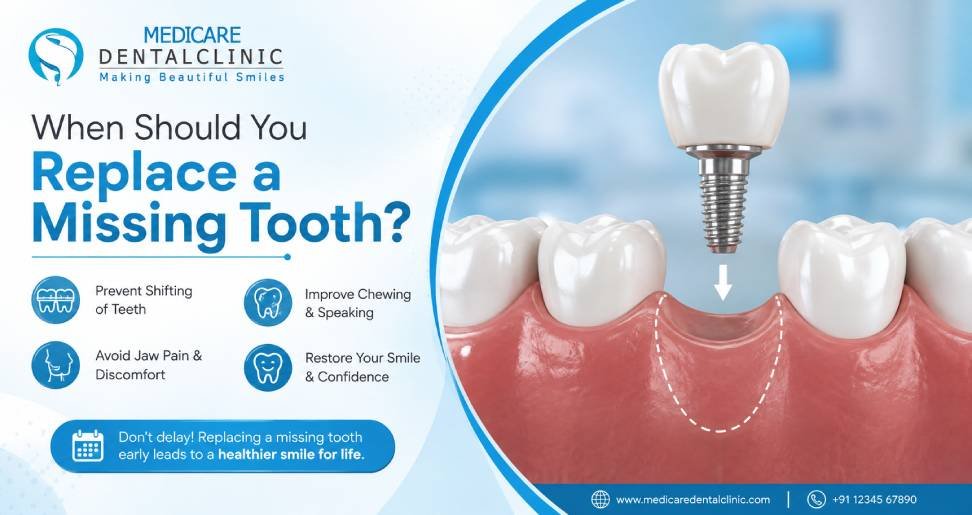
A missing tooth can affect much more than the appearance of your smile. It may make chewing difficult, change the way your remaining teeth meet, and gradually affect your oral health. While some people postpone tooth replacement because there is no immediate pain, waiting too long can allow additional dental problems to develop.
At Medicare Dental Implant Center, tooth replacement is approached with a focus on restoring both function and confidence. But how do you know when it is time to replace a missing tooth? The answer depends on factors such as your oral health, the location of the missing tooth, bone condition, and overall dental needs.
Why Should a Missing Tooth Be Replaced?
When a tooth is lost, the surrounding teeth and jawbone no longer receive the same support and stimulation. Over time, this can create changes in your mouth.
One common concern is bone loss. The roots of natural teeth stimulate the jawbone. When a tooth is missing, that stimulation decreases, which can gradually cause the bone to shrink in the affected area.
A missing tooth can also cause neighboring teeth to shift into the empty space. This may affect your bite and make cleaning between teeth more difficult. In some cases, changes in the bite can contribute to additional wear or discomfort.
Replacing a missing tooth can therefore help restore chewing ability, maintain better tooth alignment, and support a healthier-looking smile.
When Is the Right Time to Replace a Missing Tooth?
There is no single timeline that applies to everyone. However, it is generally better to discuss tooth replacement with a dentist soon after tooth loss rather than waiting for problems to appear.
1. After Tooth Extraction
If a tooth has been removed because of severe decay, infection, fracture, or gum disease, your dentist may discuss replacement options once the area has healed appropriately.
In some cases, an implant can be planned around the time of extraction. In others, healing time may be necessary before treatment begins. Your dentist will evaluate the condition of the extraction site and surrounding bone before recommending the appropriate approach.
2. When Chewing Becomes Difficult
A missing tooth can make it harder to bite or chew certain foods, especially if the missing tooth is in an important chewing area. You may unconsciously rely more heavily on the opposite side of your mouth.
If this has become a regular habit, it may be worth discussing tooth replacement with your dentist. Restoring the missing tooth can help distribute chewing forces more evenly.
3. When Nearby Teeth Start Moving
The empty space left by a missing tooth can encourage neighboring teeth to move toward it. This movement may gradually change your bite and create spaces that are harder to clean.
Replacing the tooth can help prevent further movement and restore the natural balance of your bite.
4. When You Notice Changes in Your Appearance
Front teeth play an important role in your smile and facial appearance. A missing front tooth can affect your confidence when speaking, smiling, or interacting socially.
Modern tooth replacement options can be designed to closely resemble natural teeth in shape and appearance, helping restore a more complete smile.
Are Dental Implants a Good Option for Missing Teeth?
Dental implants are one of the widely used options for replacing missing teeth. An implant uses a small biocompatible post that is placed into the jawbone to support a dental crown, bridge, or other restoration, depending on the treatment plan.
Unlike a traditional removable denture, an implant-supported restoration is designed to provide a more stable replacement. Because the implant is positioned in the jawbone, it can also provide stimulation that helps support the bone around the treatment area.
However, dental implants are not automatically suitable for everyone. Your dentist may need to evaluate your gums, jawbone, oral hygiene, medical history, and overall dental condition before treatment.
If you are considering this option, you can learn more about Dental Implants in Baghjatin and discuss whether implant treatment may be appropriate for your specific needs.
What Happens If You Wait Too Long?
Delaying treatment does not always cause immediate symptoms, but the condition of the mouth can change over time.
Possible consequences of leaving a tooth unreplaced include:
- Gradual jawbone loss in the missing-tooth area
- Movement or tilting of neighboring teeth
- Changes in your bite
- Difficulty chewing certain foods
- Increased food accumulation around the empty space
- Possible changes in facial support when multiple teeth are missing
- Reduced confidence because of the appearance of the smile
These effects do not occur in exactly the same way for everyone. A dental examination can help determine whether delaying replacement is likely to create problems in your particular situation.
What Are the Main Tooth Replacement Options?
Your dentist may recommend different solutions depending on how many teeth are missing and the condition of your remaining teeth.
Dental Implants
Implants can replace individual missing teeth and may also be used to support bridges or dentures. They are designed to provide a stable foundation for a dental restoration.
Dental Bridges
A bridge can replace one or more missing teeth by using adjacent teeth or implants as support. It can provide a fixed replacement without requiring a removable appliance.
Dentures
Partial or complete dentures may be suitable when several or all teeth are missing. Modern dentures can be designed to improve both appearance and chewing function.
The best option depends on your oral health, budget, preferences, bone condition, and long-term dental goals.
Why Professional Evaluation Matters
Choosing a tooth replacement option should not be based solely on appearance or cost. A dentist needs to examine your teeth, gums, bite, and jawbone before recommending treatment.
If you are looking for the Best Dental Clinic In Jadhavpur, choose a dental center where your condition can be properly evaluated and your treatment options explained clearly. A personalized assessment can help you understand what is appropriate for your smile rather than selecting a treatment based on general information.
Can a Missing Tooth Be Replaced Years Later?
In many situations, yes. A missing tooth does not necessarily become impossible to replace simply because several years have passed.
However, long-term tooth loss may result in changes to the jawbone and surrounding teeth. If there is insufficient bone for implant placement, additional procedures may sometimes be considered to improve the foundation for treatment.
This is why it is useful to seek an evaluation even if you have been living with a missing tooth for a long time.
When Should You See a Dentist?
Consider scheduling a dental consultation if you:
- Have recently lost a permanent tooth
- Have had a tooth extracted
- Have difficulty chewing because of a missing tooth
- Notice neighboring teeth shifting
- Feel uncomfortable about a gap in your smile
- Have multiple missing teeth
- Have been living with a missing tooth for several years
If you are searching for a Dental Clinic near Naktala, a professional evaluation can help you understand the available replacement options and determine what may work best for your oral health.
Conclusion
A missing tooth should not be ignored simply because it does not cause pain. Over time, tooth loss can affect chewing, tooth alignment, jawbone health, and the appearance of your smile. In many cases, discussing replacement options early can make treatment planning easier.
Whether you are considering a dental implant, bridge, or denture, the right solution depends on your individual dental condition. Medicare Dental Implant Center can help you understand your options through a personalized dental evaluation and treatment plan.
If you have a missing tooth, don’t wait until surrounding problems develop. Schedule a dental consultation and take the first step toward restoring a healthy, functional, and confident smile.