
Most people have never heard of this procedure and that’s part of the actual problem.
You go in with a damaged tooth, and you get offered two options. Filling or crown. Most of the time that’s fine. But there’s a category of tooth damage where neither is the best answer and the thing that would work better, an inlay, just doesn’t come up.
Not because dentists are hiding it. Just because it takes longer to explain and most appointments don’t have that time built in.
So, here’s the explanation. What an inlay is, when it makes more sense than the alternatives, and what happens at each appointment.
The Filling Problem Nobody Mentions
Big fillings fail but not always, not immediately, but the pattern is consistent enough that it’s worth understanding before you find yourself replacing the same filling for the third time.
The material shrinks a little as it cures. Microscopic gaps form at the edges over time. Bacteria get back in and decay restarts underneath the filling. On top of that, a large filling pushes outward on the tooth walls as it sets. Those walls were already weakened by the cavity. The pressure adds to that. Eventually something gives.
Dental inlay vs filling is a straightforward comparison once you see it. A filling is hand-shaped inside the mouth. An inlay is made in a lab from an exact impression of the cavity and bonded in. Tighter fit. Denser material. It bonds to the walls rather than pressing against them, which means it reinforces the tooth rather than stressing it.
For small cavities, a filling is the right call. Nobody needs an inlay for a tiny pit on an upper molar. But once the cavity reaches a size where the filling takes up most of the tooth’s interior, the inlay holds up better. By quite a lot, over ten years.
The Crown Problem Is Different
Crowns get recommended when they shouldn’t sometimes. That’s not a controversial statement, it’s just true.
To crown a tooth, you must grind it down on every side to make room for the cap. That means removing healthy tooth structure permanently. When the tooth is already badly broken down, post root canal, or structurally compromised, fine. The healthy structure is already gone, and the crown is protecting what’s left.
But when the walls of the tooth are solid and only the biting surface is damaged? Grinding those walls down is unnecessary. Dental inlay onlay vs crown comes down to how much healthy tooth is still there and whether it’s worth keeping. Usually, it is.
Dental inlays and onlays both preserve that. Inlay stays within the cusps. Onlay covers one or more cusps if the damage goes further. Same basic process either way.
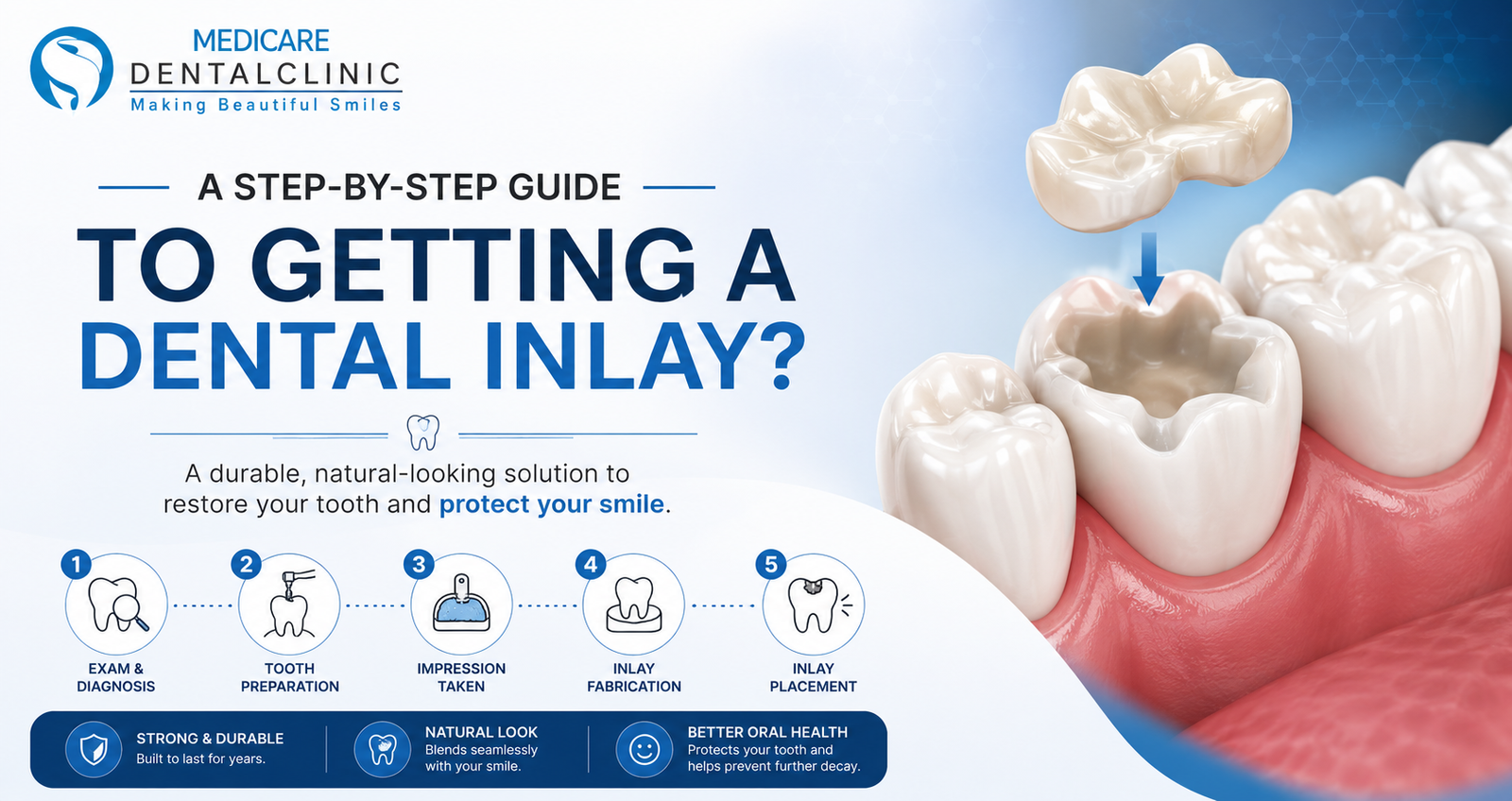
What Actually Happens at Each Appointment
First visit is two things: assessment and preparation.
The dentist looks at the tooth properly, takes X-rays, confirms the inlay is actually the right choice for this specific situation. Not every damaged tooth is an inlay candidate. Then if it is, local anaesthesia goes in, the decay comes out, and the cavity gets shaped to receive the restoration. That shaping step matters more than most patients realise. A cavity that’s prepared poorly produces an inlay that doesn’t fit right, and an inlay that doesn’t fit right causes bite problems and fails early.
A temporary filling goes in before you leave. It feels different. That’s fine. It’s temporary.
Second part of that same visit or a separate appointment depending on the clinic, the impression or scan happens. Digital scanning has mostly replaced physical impressions now. Faster, more accurate, and you don’t have to sit with trays of putty in your mouth. The scan data goes to a lab and the inlay gets fabricated.
Wait is typically one to two weeks. Eat on the other side. Don’t pick at the temporary.
Second visit is the fitting.
Temporary comes out. Inlay goes in dry first so the fit can be checked before anything is cemented. Bite gets checked. Contacts with the neighbouring teeth get checked. If something is off it gets adjusted right, then. Once everything is right, it gets bonded in and polished.
Here’s the bit people don’t know to do. After cementing, when the dentist asks how the bite feels, think about it before answering. Bite down slowly on both sides. Move your jaw side to side. If anything feels even slightly high or off, say so. A bite that’s off by half a millimetre causes jaw discomfort and uneven wear over months. Much easier to fix at that appointment than at the next one.
Before You Go In
Grinding or clenching at night. Tell the dentist before the procedure. It changes what material is recommended because porcelain chips under heavy repeated force and gold handles it better.
Ask if the clinic does in-house milling. Some can do the whole thing in one visit using CAD/CAM machines. Most still send to external labs, which means two visits. Neither is wrong, just affects your schedule.
What Patients Ask?
How long do inlays last?
Fifteen to twenty years is the realistic range with good cleaning habits and regular check-ups. Fit quality is the other variable. A well-fitted inlay on a well-maintained tooth outlasts most other restorations at that size.
Does it hurt?
No more than any other dental procedure done under anaesthesia. Pressure during the preparation, sensitivity for a day or two after, then nothing.
More expensive than a filling?
Upfront yes. Over ten years, often not. An inlay on a tooth that would have needed three filling replacements and eventually cracked costs less than that sequence by a fair margin.
The Longer Version of Why This Matters
Decay that gets caught at the inlay stage is the best point in the whole timeline to catch it.
Past that it reaches the nerve. Root canal. And if the tooth doesn’t hold up after that or cracks, extraction. And then a gap, and then an implant or bridge to deal with the gap. Every step in that sequence costs more, takes longer, and is harder on the patient than the previous one.
An inlay is the version of this story where none of that happens.
Medicare Dental Clinic handles inlay and onlay cases with digital scanning, quality lab fabrication, and enough time at the fitting appointment to actually get the bite right before you leave. If a tooth has been flagged or a large filling keeps failing, that’s the place to start.
Read More:
Visit Us: