
There is a dental option that most patients never hear about. In many dental visits, a patient with a damaged tooth is given two choices, a filling or a crown. The patient chooses one and leaves, often unaware of a third option that may be a better fit.
That third option is dental inlays and onlays. And the reason most people haven’t heard of them isn’t because they’re new or experimental. It’s just that most clinics don’t bring them up unless you ask. Which you can’t do if you don’t know they exist. Here we will discuss in detail about that.
What Is a Dental Inlay?
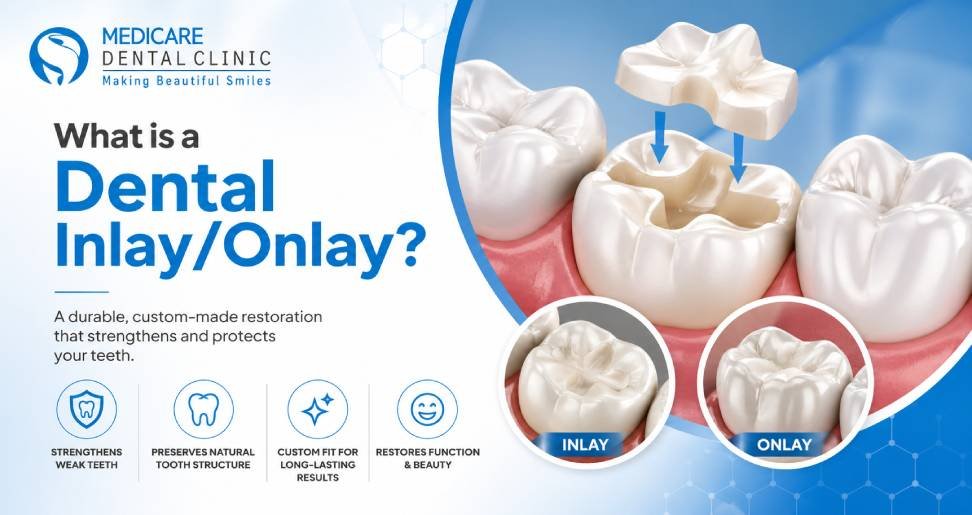
A back tooth has a chewing surface with a hollow centre and raised edges around the outside. Those raised edges are called cusps.
An inlay fills the hollow part; it doesn’t touch the cusps at all.
What makes it different from a regular filling is how it’s made. A filling goes in wet and hardens inside your mouth. An inlay is made in a lab first, shaped precisely to fit your tooth’s exact dimensions, then cemented in permanently. Porcelain, composite, or gold depending on what suits the case.
The fit is tighter, the material is harder, so it lasts longer. For anyone who’s had the same large filling replaced two or three times, this is usually why.
What’s an Onlay?
Same idea as an inlay, just more of it.
An onlay goes into the hollow and covers at least one of the cusps sometimes more. Think of it as a partial crown that doesn’t go all the way around the tooth.
It’s used when the damage has spread beyond the hollow and the cusps are cracked, weakened, or gone. But the rest of the tooth is still fine and healthy worth keeping.
An onlay saves that healthy tooth structure. A crown would just grind it all down anyway.
Dental Inlay vs Filling and Why It Actually Matters
Fillings shrink a little as they set, this isn’t a flaw exactly; it’s just how the material works. But over time that shrinkage creates tiny gaps at the edges where bacteria get back in. That’s usually why large fillings fail repeatedly.
The inlay dental procedure skips that problem entirely. It’s made outside your mouth to exact measurements and bonded in. No shrinkage. No gaps forming years later. And because it bonds to the tooth walls rather than just filling space, it makes the tooth stronger.
For small cavities, a filling is perfectly fine. For anything moderate to large on a back tooth, an inlay is a better long-term call. Most patients just never get told that.
Dental Inlay Onlay vs Crown
Crowns get recommended more often than they should. Not always but often.
To fit a crown, the dentist must grind down the whole tooth on every side. Healthy structure gone. Permanently. You’re then dependent on that crown for the rest of the tooth’s life.
If a tooth is badly broken or had a root canal, fine. A crown makes sense. But if most of the tooth is still intact and only one area is damaged, an onlay does the job without destroying everything around it.
The principle is simple: remove only what’s necessary. Nothing more. An onlay fits that. A crown often doesn’t.
The 7 Differences Between Inlays and Onlays
1. Where it sits
Inlay stays inside the cusps and onlay covers one or more cusps on top of that.
2. What kind of damage it addresses
Inlay for damage contained to the hollow centre and onlay when the cusps are involved.
3. How much protection it offers
An onlay actively reinforces the cusps it covers. An inlay restores but doesn’t extend beyond the inner surface.
4. Its relationship to a crown
Onlays are sometimes called partial crowns. Inlays aren’t comparable to crowns at all.
5. When your dentist recommends each one
Intact cusps mean inlay. Compromised cusps mean onlay.
6. How much drilling is needed
Both need less drilling than a crown. Onlays need slightly more prep than inlays because of the cusp coverage.
7. How long they last
Both well outlast standard fillings. Twenty to thirty years is normal with proper care.
Frequently Asked Questions ( FAQs ) :-
Ans :- Depends on your plan. Some treat them like fillings. Some like crowns. Worth checking before you commit.
Ans :- Local anaesthesia handles the procedure. A day or two of sensitivity after is common and goes away on its own.
Ans :- Usually, two but first to prepare the tooth and take impressions. Second to fit and cement the permanent restoration.
Ans :- You don’t, and honestly you shouldn’t have to. Your dentist looks at the X-ray and the extent of damage and makes that call.
Final Thoughts
Fillings fail. Crowns remove healthy tooth structure that didn’t need to go. Somewhere between those two outcomes, inlays and onlays have quietly been solving this problem for years.
Most people never find out about them because the conversation doesn’t come up.
Medicare Dental takes a different approach. Before recommending any restoration, the full picture is assessed, including what is damaged, what is still healthy, and the least invasive solution. If a tooth has been causing problems and you want a second opinion, it is worth a conversation.
Have A Look :-